
You are currently browsing the category archive for the ‘Mobile & Embedded’ category.

Update (Nov 20): See also part 2 of this post.
A few days ago ars technica published an article “Google’s iron grip on Android: Controlling open source by any means necessary”.
If you are considering Android for embedded this article is a must-read to understand the severe ramifications of Google’s tight (and tightening) control on the Android technology and ecosystem.
Some quotes from the ars technica article:
- “Android is open – except for all the good parts“
- “Android actually falls into two categories: the open parts from the Android Open Source Project (AOSP) … and the closed source parts, which are all the Google-branded apps”
- “Android open source apps … turn into abandonware by moving all continuing development to a closed source model.”
- “Joining the OHA requires a company to sign its life away and promise to not build a device that runs a competing Android fork.”
- “Google Play Services is a closed source app owned by Google … to turn the “Android App Ecosystem” into the “Google Play Ecosystem”
- “You’re allowed to contribute to Android and allowed to use it for little hobbies, but in nearly every area, the deck is stacked against anyone trying to use Android without Google’s blessing“
Compare this with a recent Wired article “Oracle Makes Java More Relevant Than Ever”:
“Oracle has actually opened up Java even more — getting rid of some of the closed-door machinations that used to be part of the Java standards-making process. Java has been raked over the coals for security problems over the past few years, but Oracle has kept regular updates coming. And it’s working on a major upgrade to Java, due early next year.”
Cheers,
— Terrence

Embedded @ JavaOne is really coming into its own this year. Lots of cool and relevant topics, content, and activities related to Java and embedded. A quick sampler:
Keynotes:
Be sure to watch the JavaOne keynotes for embedded announcements and some cool demos …
Sessions:
- Java Embedded Extreme Mashups: Building Self-Powering Sensor Nets for the Internet of Things TUT3676]
- Home Automation for Geeks [CON9177]
- Trust Me, I’m an M2M Device [CON7872]
- Is It a Car? Is It a Computer? No, It’s a Raspberry Pi JavaFX Informatics System [CON3243]
- JavaRCX: A Java Embedded Lego Mindstorm RCX Emulator [BOF7901]
- Beyond Beauty: JavaFX, Parallax, Touch, Raspberry Pi, Gyroscopes, and Much More [CON2540]
- Industrial Product Development: Modular Design in Multiple Dimensions with Java [CON2027]
- Performance Tuning and Optimization of Apache Hadoop with Java Embedded on ARM [BOF7216]
- Creating Multidevice Interactive Entertainment for the Living Room with Java [CON9176]
- Controlling NAO Robot with Java [CON11839]
- Java ME 8 Overview: A New Platform for Embedded Development for Small Devices [CON2267]
- and much more … for a full list of sessions, see the Content Catalog.
Internet of Things with Partners:
A summary of various demos, sessions, and activities by Oracle, Eurotech, and Hitachi related to the Internet of Things.
DEMOGrounds:
- A number of demos around embedded use cases, technologies, and solutions by partners across the ecosystem, including the “Device Showcase”
Duke’s Choie Awards:
- Be sure to watch for innovative embedded solutions with Java
Java Embedded Challenge for Raspberry Pi:
- Fun and creative hacking with Raspberry Pi, sensors, and more – equipment and expertise provided.
OTN Lounge and Java Codegarten:
- Hang out with the experts, including specialists in Java Embedded.
For more information on the above, check out the JavaOne Experiences page.
See you in a few days at the show!
Cheers,
— Terrence

Obfuscation is a really helpful mechanism to reduce the size of your Java ME Embedded application code to a minimum.
When developing Java embedded applications using the Java ME SDK 3.3 with NetBeans you would normally be able to easily install the ProGuard obfuscator via the NetBeans ProGuard plugin and then set it to automatically obfuscate every project build.
However, for NetBeans 7.3 a licensing incompatibly prevents the ProGuard plugin to be available directly on the NetBeans 7.3 update center. This issue has been fixed for the upcoming NetBeans 7.4.
If you want to use ProGuard with NetBeans 7.3 there is an easy workaround described on the NetBeans bug tracker: https://netbeans.org/bugzilla/show_bug.cgi?id=227701. Scroll down to the end of the thread to see:
——————————————–
For now it is possible to use following workaround for proguard:

1. Download proguard.jar from http://sourceforge.net/projects/proguard/files/proguard/
2. Insert following line in {YOUR_PROJECT_DIR}/nbproject/private/private.properties OR {NB_USERDIR}/build.properties (no need to insert in both):

obfuscator.classpath={PATH_TO_proguard.jar}

(e.g. obfuscator.classpath=C:\\JavaME\\Proguard\\proguard.jar)
——————————————-
Hope this helps. Cheers,
— Terrence

Just a quick reminder to participate in the upcoming Java Virtual Developer Day tomorrow or June 25th. More information on my previous post.
Cheers,
— Terrence

What’s New?
We’ve gotten excellent feedback on these releases and have found and fixed a couple of bugs and glitches and made usability enhancements. In keeping with the rapid evolution of the technology, we are today making available a set of refreshed bits:
- Oracle Java ME Embedded 3.3.1 EA for ARM Cortex-M3/M4
- Updated Oracle Java ME Embedded 3.3 EA for Raspberry Pi
- Updated Oracle Java ME SDK 3.3 EA and updated plugins for NetBeans and Eclipse
We have also expanded the documentation that comes with these releases as well as updated the embedded sample code that is available with the Java ME SDK 3.3 EA.
Developer should start using these updated releases right away to benefit from the improvements.
Important Notes For Installation:
- You should update all versions together. The integration between the runtimes (1 and 2) and the tools (3) will work best if all are updated at the same time. So please uninstall previous versions of Java ME SDK 3.3 EA (via Windows “remove software”) and the NetBeans and Eclipse plugins (via plugin management) and then install the updated versions.
- When installing the updated NetBeans plugins, you should use the manual installation method as described in the chapter 2-4 of the “Getting Started Guide for the Windows Platform”. The reason is that the NetBeans update center still contains the plugin versions of Java ME SDK 3.2 GA release (not 3.3 EA).
Getting Started:
Be sure to check out the improved and expanded “Getting Started Guides” and “Release Notes” for the platform you plan to use. Refer to the OTN Java Embedded Documentation Tab and expand on the section “Oracle Java ME Embedded 3.3 Release” (see screen shot).
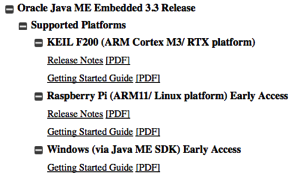
It’s best to start with the Windows (via Java ME SDK) “Getting Started Guide for the Windows Platform”, which explains how to install the Java ME SDK and configure NetBeans and Eclipse.
To access the refreshed bits for the Oracle Java ME Embedded runtimes and the Java ME SDK, please go to the download page (be sure to refer to the section for the 3.3 releases).
Where to Learn More and Get Help:
- Be sure to attend the upcoming Virtual Developer Day – Java (June 19 and 25), which has a dedicated slot on Oracle Java ME Embedded 3.3.
- Check out the full set of documentation, and the videos/webcasts on the Oracle Java ME Embedded 3.3 Resources Page (further links can be found on my blog as well).
- Ask questions on the OTN Java ME Embedded forum.
- Email us at: java-me-embedded-feedback_ww_grp@oracle.com
Cheers,
— Terrence

Java Day Tokyo is happening next Tuesday, May 14 at the AKIHABARA UDX.
It will be a packed day of information, from keynotes to technical sessions, demos, and lightning talks – covering Java EE, Java SE, JavaFX, Java ME, and, of course, Java Embedded.
I will be there, talking about “Java in the Internet of Things: Small, Smart, Connected”.
Hope to see you on Tuesday!
Cheers,
— Terrence
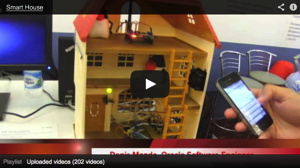
JavaOne in Russia ended yesterday, with over 2000 developers attending.
Embedded Java was a a hot topic (as it is pretty much everywhere these days) – check out the video on the Smart Home demo with Java ME Embedded on Raspberry Pi, and catch up with other demos and things happening at JavaOne Russia.
Cheers,
— Terrence

Tomorrow (April 24th) I will be at the JAX Conference in Mainz, Germany for the Embedded Experience Day, talking about “Java in the Internet of Things: Small, Smart, Connected” (at 14:00).
There will also be an “Embedded Werkstatt” (open 10:00-17:00) with different exhibits and demos and the opportunity to ask the experts and discuss embedded topics.
See you tomorrow in Mainz!
Cheers,
— Terrence

Today (April 23rd) is the LAST DAY to submit a proposal for JavaOne San Francisco 2013.
For more information, see here.
Cheers,
— Terrence
PS: My offer for extra credit for doing something fun with Java ME Embedded on Raspberry Pi still stands!

Now that a lot of folks are kicking the tires with Java ME Embedded (see the last couple of blog posts), I just wanted to make sure you know where to go with questions:
- Lots of good resources are here and here (including “Getting Started Guides”, FAQ, videos, and API documentation)
- Check out the OTN Java ME Embedded forum and ask questions – our experts are monitoring these regularly
- Email us at: java-me-embedded-feedback_ww_grp@oracle.com – we’ll get back to you
Cheers,
— Terrence

 Across the Universe
Recent Comments