
You are currently browsing the tag archive for the ‘embedded’ tag.

Questions on IoT? Meet Electric Imp at IoT World in Santa Clara next week (May 10-12).
More info here.
Cheers,
— Terrence

Quick update on yesterday’s announcement: Check out this Fortune magazine about Pitney Bowes and Electric Imp.
Cheers,
— Terrence

After what seems like an eternity at Sun and Oracle I have decided to pursue a new opportunity … I recently joined Electric Imp.
Electric Imp solves the challenges of the last mile of IoT solutions by providing a secure, connected, and programmable edge device platform, industrial-grade connectivity, and ease of integration into enterprise applications. Electric Imp is already deployed across a wide range of customers and industries.
In fact, just today Electric Imp announced a private cloud offering for commercial and industrial markets as well as being a strategic IoT connectivity partner for Pitney Bowes.
So I’ll definitely be staying in the embedded/IoT space – exciting times ahead. More to come … stay tuned.
Cheers,
— Terrence

The slides of my two JavaOne talks should show up in the JavaOne 2015 Session Catalog soon, in the meantime you can access them via SlideShare:
- CON3434: Bringing IoT Cloud Services to Edge Devices with Java ME Embedded 8
- CON3437: Smart devices for the Internet of Things: Java ME Embedded 8.2 and Beyond
Cheers,
— Terrence


Update on 10/16: Added info related to the Java Hub
Yes, another year has raced past and JavaOne San Francisco is here again – Oct 25 through 29!
And yes, as usual, it’s a packed week again: Keynotes, demos, Exhibition Hall, MakerZone, networking, party, … and more than 450 sessions!
If embedded, small devices, and Internet of Things is your cup of Java (excuse the pun), here is – as every year – my (totally subjective) JavaOne guide. Watch for updates as we get closer to the event, but for now – here is the first pass:
General:
- JavaOne4Kids (Saturday)
- JavaOne Keynotes (including Java ME in several segments): Intel, Oracle (Sunday)
- Throughout the conference
- Exhibition Area
- Java Hub (3D Modeling, Geek Bar, Hackergarten, MakerZone, myMatrix, Nighthacking, and OTN Community Cafe). Check out the Java ME Java ME R/C car/Internet of Things demo in the MakerZone and hang out with us at the Geek Bar for Q&A.
My sessions:
- CON3434: Bringing IoT Cloud Services to Edge Devices with Java ME Embedded 8
- CON3437: Smart devices for the Internet of Things: Java ME Embedded 8.2 and Beyond
Highly recommended sessions:
- TUT10744: Getting Started with Java ME Embedded on the STMicro Cortex-M4 and Other Devices (STM, Oracle)
- CON4075: There Is Business in Java and IoT (Oracle)
- CON11181: Accelerating IoT with ARM (ARM)
- CON10322: A Comprehensive Smart Home Platform Powered by Java ME and Java EE (Blueberry Zone)
- CON11180: ARM Cortex-M and Java in the Internet of Things (ARM)
- CON9758: Building a Trusted Gateway with Java ME and Secure Element (Gemalto)
- CON5106: Enabling Your Device to Be Part of the Internet of Things (MicroDoc, Hepa Wash)
- CON6694: From Product to Services in the Embedded World, Thanks to Java ME 8 and STM32 MCU (STM)
- CON2588: Internet of Things: Threats and Countermeasures with Java (Oracle)
- CON11279: Introducing the Oracle Internet of Things Cloud Service (Oracle)
- UGF10301: James Gosling, Robots, the Raspberry Pi, and Small Devices (Liquid Robotics, code centric, Gluon, QAware)
- BOF6850: Project Kona: Java Networking Technologies for the Internet of Things (ARM, Oracle)
- CON6489: Smart Open Spaces Powered by Java ME, Java SE, and Single-Board Computers (Accenture)
- CON5508: Using Java on Edison to Communicate with Wearable Sensors (Intel)
- CON4805: Increased Developer Productivity for IoT (Bitreactive, Oracle)
- CON7339: Providing Eyes, Ears, and a Mouth to Your IoT Project (Globalcode)
Other interesting sessions:
- CON5364: IoT: What Is in It for Java Professionals? (GE, Oracle)
- CON2582: Java Card Platform Evolution (Oracle)
- CON4876: How to create a Voting Machine (Canoo, Oracle)
- BOF5849: PixyBot: Creating a Programmable, Object-tracking Robot (Goethe Center, Oracle)
- CON2984: IoT Realized: The Connected Car (Pivotal)
- HOL6159: Let’s Have Fun with Robot APIs (Aldebaran)
More Details:
See Agenda, Content Catalog.
See you soon in San Francisco!
Cheers,
— Terrence
Just released:
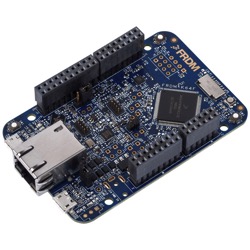
- Oracle Java ME Embedded 8.2: Now even smaller!
- Oracle Java ME SDK 8.2: Now with Linux tooling support!
Check out the details in the blog entry of my college Alex Belokrylov.
Stay tuned for more Java ME Embedded-related announcements in the coming weeks.
Cheers,
— Terrence
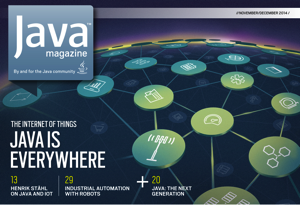
I wanted to draw your attention to a lot of good coverage of embedded topics in the last two issues of Java Magazine:
Current Issue (November/December):
- Theme: Internet of Things – Java is Everywhere. Interview with Henrik Stahl, VP Product Management, Oracle
- JCP Awards for JSR 360 (CLDC 8) as “Most Significant JSR” and JSR 360 Spec Lead Michael Lagally as “Outstanding Spec Lead”
- JCP Executive Series: Freescale’s Maulin Patel and The Java Advantage for IoT
- Robots Make Factories Smarter
- Code Java on the Raspberry Pi
- A Smart-Home Platform for the Mass Market
- The Device I/O API
Previous Issue (September/October):
- Duke’s Choice Award for Perrone Robotics and their driverless cars and PiDome Home Automation and Internet of Things platform
- The Maker Movement Evolves
- Winners of the IoT Developer Challenge
- Introducing Roboburgh
- JCP Executive Series: ARM’s Zach Shelby and The Rise of the Machines
- Fun and Games with Greenfoot and Kinect
- Getting Started with Home Automation
To view and subscribe, see here.
Cheers,
— Terrence

Update:
- 10/9/14: See also the JavaOne interview with Dimitar Valtchev, CTO of ProSyst
Last week at JavaOne, ProSyst announced a Scalable Device Management Solution System for Java ME devices, see here for the press release.
Using the ProSyst mPRM backend and cloud remote device management solution allows customers to remotely monitor and manage gateways and end devices, based on both Java SE and Java ME, from a single management domain using a range of device management operations and protocols.
mPRM has been shown to scale to more than 4,000,000 online devices in simulated operations on Oracle Exalogic Elastic Cloud systems, and is in commercial use at a number of large service providers.
Another good reason to consider Java Embedded for your next IoT solution.
Cheers,
— Terrence

About 18 months ago we embarked on an ambitious journey to deliver a major update of the Java ME platform standard by filing JSR 360 (CLDC 8) and JSR 361 (MEEP 8) in the JCP (“JSR 360 and JSR 361: A Big Leap for Java ME 8”).
Both JSR 360 and JSR 361 were unanimously approved this week, with 25 YES votes each. Java ME 8 is now a reality, bringing the power of Java 8 to small embedded. Stay tuned for more announcements soon.
In the meantime, for be sure to check out my webcast “Introduction to Java ME 8” or the ”Java ME 8 Deep Dive” presentation.
Cheers,
— Terrence
A host of new content was released with the recent Java 8 launch and the YouTube Java channel features a number of interesting videos and interviews. For example:
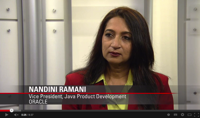
“Building Block for the Internet of Things”, Nandini Ramani, VP of Java Product Development, Oracle
Get a new perspective on how enterprises may generate value from IoT and what it takes to make IoT work. Learn about key building blocks for IoT solutions. Get an overview of how Oracle’s products, including Java, enable end-to-end IoT deployments.

“Turning Devices into a Value-Generating Application Platform with Java”, Axel Hansmann, VP Strategy and Marketing Communication M2M, Gemalto
Learn about Gemalto’s vision for the future of IoT, strategy using Java, and adoption plans for Java ME 8. Find out more about Gemalto’s technologies and how they are used, from quick IoT/M2M prototyping to full-scale enterprise solutions.
I’ll be pointing out more interesting videos and content over the next couple of weeks.
Cheers,
— Terrence

 Across the Universe
Recent Comments